Haruichi Furudate began serializing Haikyuu!! in Weekly Shonen Jump in February 2012, and by the time the final chapter ran in July 2020 the story filled 45 volumes and had turned an unremarkable high school volleyball club into one of the most recognizable sports properties in manga. The Production I.G anime adaptation arrived in 2014 and kept the same narrow focus: Karasuno High School in Miyagi Prefecture, a program once strong enough to be feared and now known mostly as the fallen champions, trying to climb back toward the national stage. What separates it from most tournament stories is the attention it pays to the parts of volleyball that are not spectacular. Receives, blocking reads, serve rotations, and the quiet arithmetic of who covers which zone get as much screen time as the spikes do.
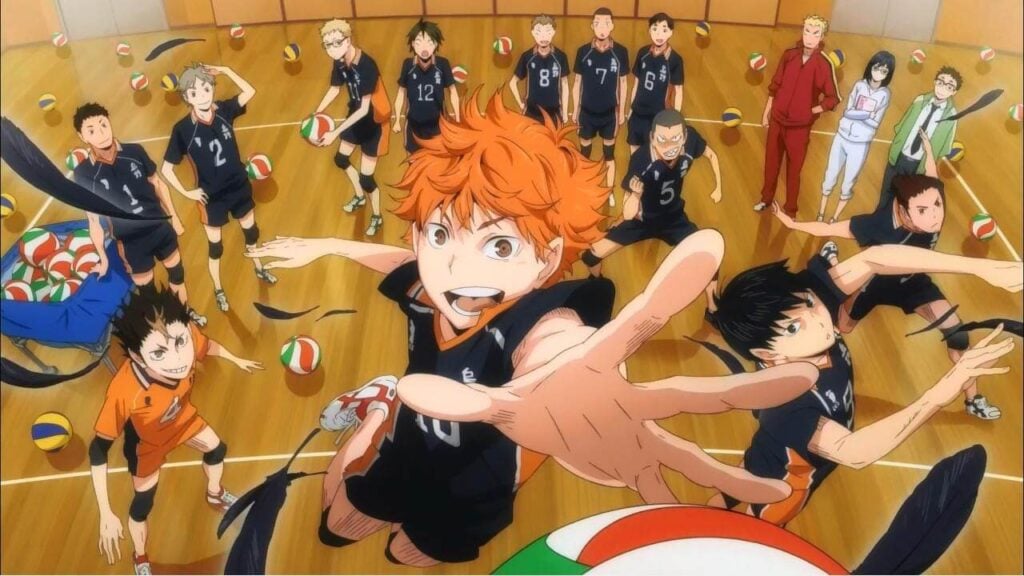
The engine of the story is the pairing of Shoyo Hinata and Tobio Kageyama, two players who by any reasonable standard should not function together. Hinata is roughly 162 centimeters tall, arrives with almost no technique, and compensates with a vertical leap and a stubbornness that survives every loss. Kageyama is a setter with textbook precision and a middle school reputation so bad that his own teammates stopped swinging at his tosses, which is where the nickname King of the Court came from. Their quick attack works only because one of them stopped demanding obedience and the other stopped needing to watch the ball leave the setter’s hands.
The quiz matches you with one of these players, along with the managers and coaching staff who hold the club together off the court. The sorting rests on how you handle pressure, how you deal with people who are better than you at something you care about, and what you do with the parts of a job that nobody notices.
The results genuinely pull in different directions. Daichi Sawamura is the captain whose authority comes from absorbing chaos rather than creating it, the person who keeps six volatile personalities pointed at the same objective. Kei Tsukishima spends most of the early story protecting himself with irony, treating effort as embarrassing because caring openly means risking a loss, and his slow abandonment of that stance is one of the series’ better arcs. Yu Nishinoya, the libero, is his opposite in almost every measurable way: loud, physically fearless, and completely uninterested in whether diving across a gym floor looks dignified. Hitoka Yachi joins as a manager convinced she has nothing to contribute and turns out to be the one who notices details everyone else misses. Ittetsu Takeda, the faculty advisor, knew nothing about volleyball when he took the club and made himself useful anyway by writing letters and arranging practice matches other schools would not have offered.
Answering honestly matters more than answering the way a favorite character would. Someone who quietly steadies a room lands somewhere very different from someone who needs the last point on their own terms, and the result you get says more about your instincts under pressure than about your knowledge of the series.
Possible results:
- Shoyo Hinata
- Tobio Kageyama
- Daichi Sawamura
- Koshi Sugawara
- Asahi Azumane
- Yu Nishinoya
- Ryunosuke Tanaka
- Chikara Ennoshita
- Kei Tsukishima
- Tadashi Yamaguchi
- Kiyoko Shimizu
- Hitoka Yachi
- Ittetsu Takeda
- Keishin Ukai
- Tetsuro Kuroo