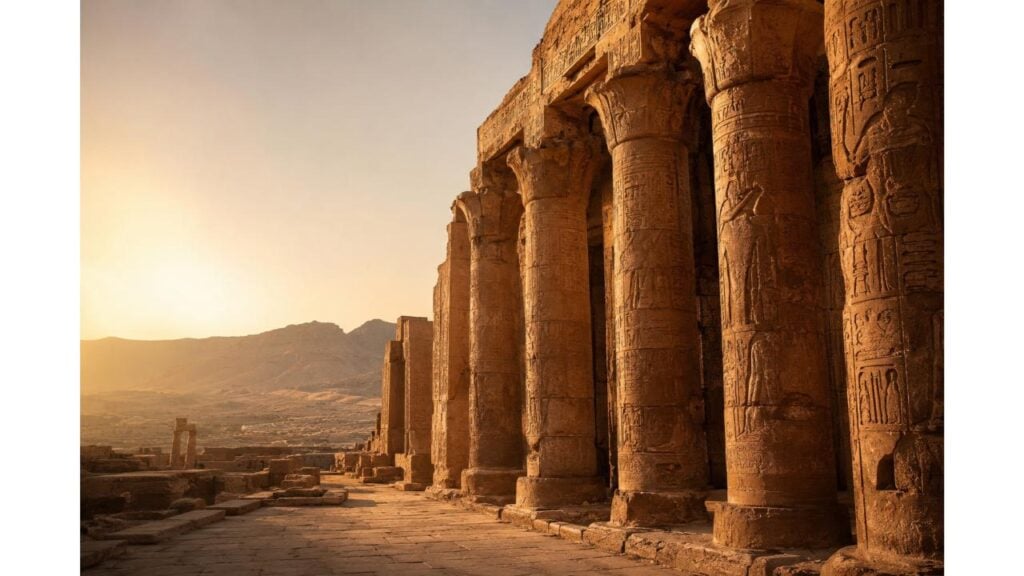
Of the Seven Wonders of the Ancient World, only one is still standing, and it’s been standing for roughly four and a half thousand years. The Great Pyramid of Giza was built as a tomb for a single pharaoh, using an amount of precisely cut stone that still puzzles modern engineers about exactly how it was accomplished with Bronze Age tools. That’s the kind of scale ancient Egypt operated at consistently: a civilization that built monuments meant to outlast empires, developed one of the earliest writing systems in human history, and organized an entire society around the belief that death wasn’t an ending but a transition requiring very specific, very deliberate preparation.
Khufu, the Fourth Dynasty pharaoh that pyramid was raised for, ruled somewhere around 2560 BC and left behind a structure that originally stood about 146 metres tall and held the record as the tallest building on Earth for roughly the next 3,800 years, until European cathedral spires finally passed it. Erosion has taken the top several metres and stripped away the polished limestone casing that once made the whole thing reflective. His son Khafre built the neighbouring pyramid, which looks taller only because it sits on higher bedrock, and the Sphinx crouching in front of it is generally attributed to the same reign.
Preparing a body took about seventy days. Embalmers drew the brain out through the nostrils and discarded it, packed the corpse in natron, a naturally occurring salt gathered from dried lake beds, and removed the lungs, liver, stomach and intestines into four canopic jars watched over by the four sons of Horus. The heart stayed where it was, on the reasoning that it held the intellect and the record of a person’s conduct and would be needed intact later. Wrapping used hundreds of metres of linen, with amulets set between the layers at positions the embalmers treated as fixed.
That later reckoning is described across the funerary texts collectively known as the Book of the Dead, in which the heart is weighed on a scale against the feather of Ma’at, the principle of truth and cosmic order. Anubis, jackal-headed and responsible for embalming, handles the scales; Thoth records the verdict; Osiris presides over the hall; and a composite creature called Ammit waits beside the balance to consume any heart that proves heavier than the feather, ending the deceased’s existence entirely rather than merely punishing it.
The rulers themselves cover an enormous range. Hatshepsut governed for roughly two decades in the fifteenth century BC and had herself depicted in male regalia with a false beard, after which her successor systematically chiselled her name off monuments. Akhenaten abandoned the traditional pantheon for a single sun disc and built a new capital in the desert. Ramesses II reigned for sixty-six years and fought the Hittites at Kadesh. Cleopatra VII, Macedonian Greek by descent, was the last of them. Reading any of their inscriptions was impossible until the Rosetta Stone surfaced in 1799 and Jean-François Champollion worked out the system in 1822, a century before Howard Carter opened Tutankhamun’s tomb in November 1922.
Questions here range across pyramids and the pharaohs buried in them, the gods and the judgment of the dead, the mechanics of mummification, and the discoveries that made any of it legible to modern scholars. Some are the familiar sort, like the river the whole civilization depended on. Others want a specific name, a specific stone, or the specific god who oversaw embalming. Correct answers appear with every question below once the last one is submitted.
Questions Preview
- The Tigris
- The Nile
- The Euphrates
- The Jordan
- Cremation
- Mummification
- Embalming with salt only
- Sky burial
- Tutankhamun
- Khufu
- Ramses II
- Akhenaten
- Jean-Francois Champollion
- Howard Carter
- Flinders Petrie
- Giovanni Belzoni
- Cuneiform
- Hieroglyphics
- Runes
- Sanskrit
- The Nag Hammadi library
- The Rosetta Stone
- The Dead Sea Scrolls
- The Book of the Dead
- Nefertiti
- Cleopatra VII
- Hatshepsut
- Nefertari
- Ra
- Anubis
- Horus
- Thoth
- Canopic jars
- Amphorae
- Sarcophagi
- Reliquaries
- Osiris
- Ra
- Set
- Geb
- The Valley of the Kings
- The Giza Plateau
- The Temple of Karnak
- The Sphinx enclosure
- The Colossi of Memnon
- The Great Sphinx
- The Obelisk of Luxor
- The Temple of Abu Simbel
- The Book of the Dead
- The Book of Thoth
- The Pyramid Texts alone
- The Amduat scroll only
- Asia
- Africa
- Europe
- South America
- None
- One
- Three
- Two