The Mongol Empire at its height covered roughly 24 million square kilometres, about sixteen percent of the land on the planet, stretching from the Sea of Japan to the edge of Hungary. It was assembled inside a single lifetime and one succession, and the thing that made it function was not the cavalry but the post: a relay network called the Yam, with stations spaced a day’s ride apart, fresh horses waiting at each one, and couriers who could carry a message a couple of hundred miles in a day across terrain that would take an army months. Temujin was proclaimed Genghis Khan in 1206 over a confederation of steppe tribes that had spent the previous century fighting each other, and within thirty years his successors were collecting taxes in Persia and Russia at the same time.
On the morning of June 28, 1914 in Sarajevo, a first assassination attempt had already failed. Nedeljko Cabrinovic threw a bomb at the Archduke Franz Ferdinand’s motorcade; it bounced off the folded roof of the car and detonated under the vehicle behind, wounding officers and bystanders. The Archduke completed his engagement at the town hall, then insisted on visiting the injured in hospital, which meant a change of route that nobody communicated to the lead driver. The driver turned into Franz Joseph Street by mistake, was told to reverse, and stalled the car directly in front of Gavrilo Princip, a nineteen-year-old who had given up and gone to stand outside a delicatessen. Franz Ferdinand and his wife Sophie were both dead within the hour. Austria-Hungary issued its ultimatum on July 23 and declared war on July 28, and a chain of alliances turned a street shooting into a war that killed some seventeen million people.
The consequences of that morning shaped the rest of the century almost mechanically. The Treaty of Versailles was signed on June 28, 1919, five years to the day after the assassination, and its Article 231 assigned Germany sole responsibility for the war along with reparations set at 132 billion gold marks, terms that hollowed out the Weimar economy and gave the next set of politicians their material. The Second World War followed in 1939 and ended in 1945, Europe was divided between the powers that won it, and Berlin ended up split down the middle. The wall through that city went up on August 13, 1961 and stayed for twenty-eight years, opening on November 9, 1989, which means one continuous causal thread runs from a wrong turn in Sarajevo to a crowd with hammers in Berlin.
Elsewhere the timelines run on entirely different clocks. Qin Shi Huang unified China in 221 BC and standardised the script, the weights, the currency and the axle width of carts so that roads would be built to one gauge, and his tomb near Xian was surrounded by an army of terracotta figures nobody knew about until farmers digging a well hit one in 1974. The Great Pyramid at Giza was already roughly two thousand years old by then, built for the pharaoh Khufu around 2560 BC, and it held the record as the tallest structure on Earth for something close to 3,800 years.
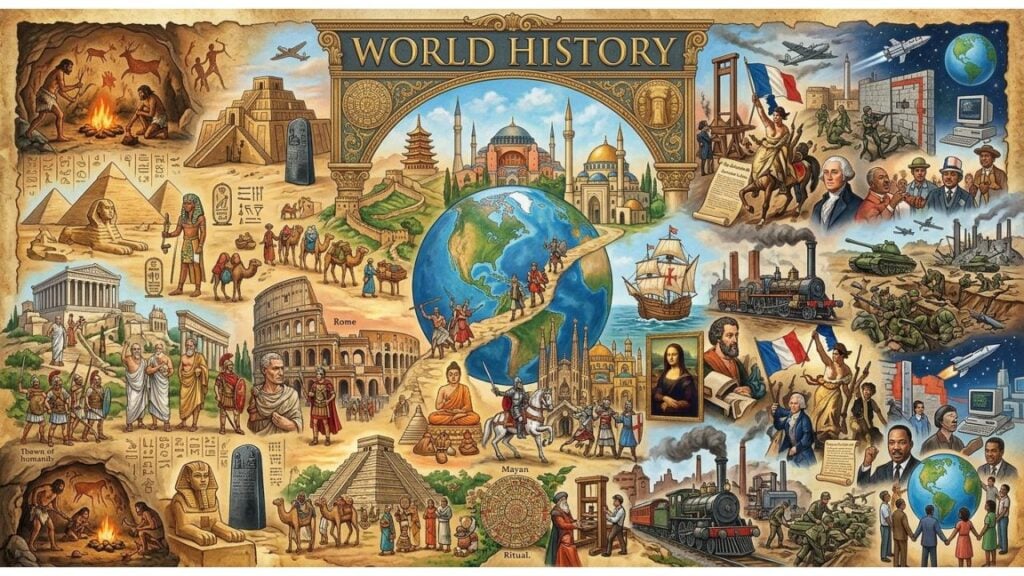
The questions range across all of that, from the empire centred on Italy and the century range the Renaissance occupied to the ship that carried the Pilgrims in 1620, the revolution that began in France in 1789 and the empire Napoleon ruled after it. Every question comes back with its correct answer below the quiz, which makes it easy to see which centuries slipped past unnoticed.
Questions Preview
- The Roman Empire
- The Mongol Empire
- The British Empire
- The Ottoman Empire
- Kublai Khan
- Genghis Khan
- Timur
- Attila the Hun
- 1943
- 1945
- 1947
- 1950
- The Industrial Revolution
- The French Revolution
- The Bolshevik Revolution
- The Glorious Revolution
- Vasco da Gama
- Christopher Columbus
- Ferdinand Magellan
- Amerigo Vespucci
- The Mesopotamians
- The Ancient Egyptians
- The Aztecs
- The Ancient Greeks
- The Great Wall
- The Berlin Wall
- Hadrian's Wall
- The Iron Curtain Wall
- The Treaty of Paris
- The Treaty of Versailles
- The Treaty of Vienna
- The Treaty of Westphalia
- The Byzantine Empire
- The Roman Empire
- The Ottoman Empire
- The Persian Empire
- The 10th and 11th centuries
- The 14th through 17th centuries
- The 19th century
- The 8th century
- The Santa Maria
- The Mayflower
- The Endeavour
- The Beagle
- Kublai Khan
- Qin Shi Huang
- Sun Tzu
- Confucius
- World War II
- World War I
- The Franco-Prussian War
- The Crimean War
- The Colossus of Rhodes
- The Great Pyramid of Giza
- The Hanging Gardens
- The Lighthouse of Alexandria
- The British Empire
- The French Empire
- The Austrian Empire
- The Prussian Empire