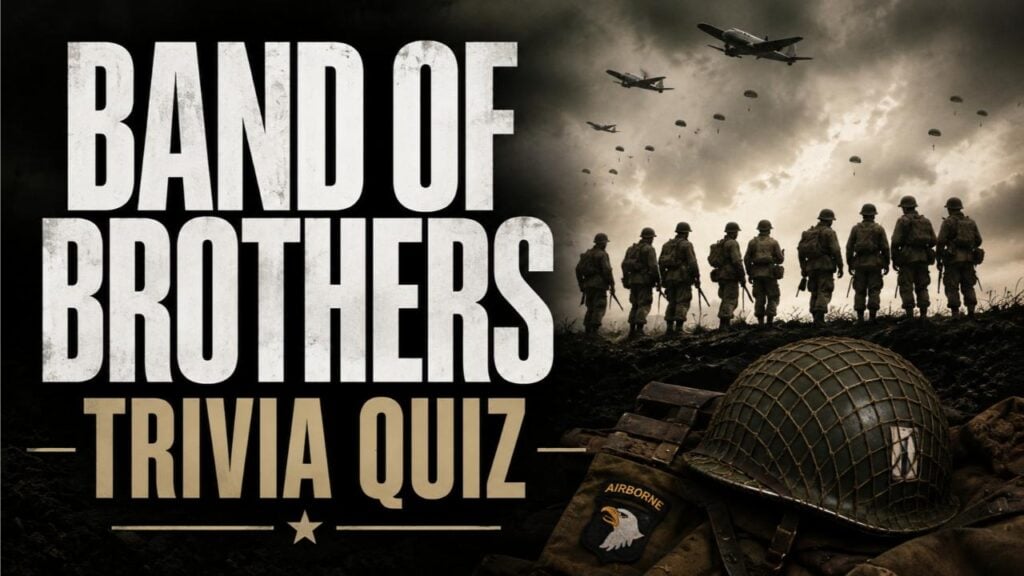
A production budget large enough to be described at the time as one of the most expensive television projects ever made went toward recreating, in exhaustive, ground-level detail, the actual combat experiences of a single US Army parachute infantry company across the final years of World War II. Band of Brothers, based on real historical research and interviews with surviving veterans, followed Easy Company of the 506th Parachute Infantry Regiment from their brutal training through D-Day, the fighting across France and the Netherlands, the brutal winter siege at Bastogne, and finally into Germany itself as the war reached its conclusion.
At Brécourt Manor on the morning of June 6, 1944, First Lieutenant Richard Winters took roughly a dozen men against a battery of four German 105mm howitzers shelling Utah Beach, defended by an estimated fifty soldiers, and knocked the guns out with a handful of casualties on his own side. The action earned him the Distinguished Service Cross and has been taught at West Point as a model for assaulting a fixed position, and the second episode reconstructs it closely enough that surviving officers could follow the sequence of moves. That approach set the standard for the rest of the series, which reproduced Operation Market Garden, the fighting around Eindhoven and Nuenen, the fixed defensive line in the Bois Jacques woods outside Bastogne, and the capture of Berchtesgaden with the same attention to who was standing where.
The source was Stephen E. Ambrose’s 1992 book, built from years of interviews with the surviving members of the company, and Steven Spielberg and Tom Hanks brought it to HBO after Saving Private Ryan. The ten-part result cost somewhere around 125 million dollars, was filmed largely at Hatfield Aerodrome in Hertfordshire on a disused British Aerospace site where Bastogne’s frozen forest and half of rural Normandy were built from scratch, and put its cast through a ten-day boot camp run by retired Marine captain Dale Dye. Damian Lewis played Winters, Ron Livingston played Lewis Nixon, David Schwimmer played the loathed Captain Herbert Sobel, and a long list of actors who were then unknown, among them Tom Hardy, James McAvoy, Michael Fassbender, Simon Pegg, and Andrew Scott, passed through in small parts.
Rather than track the company as a block, individual hours hand the camera to one man at a time. Bastogne unfolds almost entirely from the perspective of the medic Eugene Roe scrounging for bandages and morphine in a town under siege, The Breaking Point is narrated by Carwood Lipton as the officers around him crack, and Why We Fight follows a patrol that stumbles onto a subcamp of Dachau near Landsberg with no idea what they are looking at. The first episode is given over to training at Camp Toccoa and the three miles up and three miles down Currahee, and to a near-mutiny by the company’s non-commissioned officers against Sobel.
Each episode opens with the real veterans speaking directly to camera, but their names are withheld until the final hour, so viewers spend ten episodes hearing from men they cannot yet match to characters. The closing lines belong to Winters, quoting a letter from Mike Ranney about being asked whether he was a hero in the war, and the answer that he served in a company of heroes. The series took the Emmy for Outstanding Miniseries in 2002 and produced two companion projects, The Pacific and Masters of the Air. A misplaced date or name rarely survives contact with what prints out once the last question is answered.
Questions Preview
- Fox Company
- Easy Company
- Dog Company
- Baker Company
- The 82nd Airborne
- The 506th Parachute Infantry Regiment
- The 101st Infantry Regiment
- The 1st Ranger Battalion
- The invasion of Sicily
- D-Day (Normandy invasion)
- The invasion of North Africa
- Operation Torch
- Bruges
- Bastogne
- Antwerp
- Liege
- The Battle of the Bulge
- The Battle of Normandy
- Operation Market Garden
- The Battle of Berlin
- A memoir by a single soldier
- Stephen Ambrose's nonfiction book of the same name
- A collection of newspaper articles
- An official Army history report
- Ridley Scott and Robert Rodat
- Steven Spielberg and Tom Hanks
- Martin Scorsese and George Lucas
- Peter Jackson and James Cameron
- Netflix
- HBO
- Showtime
- AMC
- Operation Overlord
- Operation Market Garden
- Operation Torch
- Operation Cobra
- Narration from an unseen historian
- Real interviews with surviving veterans
- Animated maps only
- Newsreel footage exclusively
- A hidden Nazi bunker
- A concentration camp
- An enemy weapons cache
- A civilian massacre site
- Eight
- Ten
- Twelve
- Six
- France
- Germany/Austria
- Belgium
- The Netherlands
- Lewis Nixon
- Richard Winters
- Herbert Sobel
- Carwood Lipton
- He was too lenient
- He was widely viewed as an overly harsh, poor combat leader
- He refused to train the men at all
- He was absent for most of training