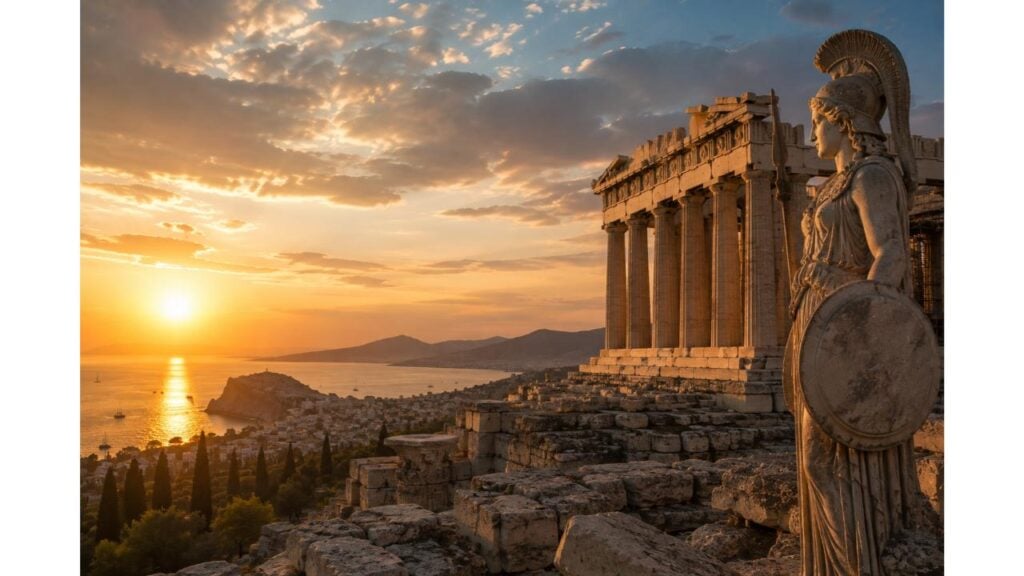
Long before superheroes, ancient Greece had its own cast of larger-than-life figures: gods who ruled the sky, sea, and underworld from a mountain in the clouds, and mortal heroes who fought monsters, sailed across the known world, and occasionally paid a devastating price for their own pride. Greek mythology has survived for thousands of years not because anyone still worships Zeus, but because the stories themselves are simply that good: messy family drama among immortals, impossible trials handed to mortal heroes, and consequences that hit exactly as hard today as they did when they were first told around a fire.
After the ten-year war against the Titans ended with Cronus and his allies confined to Tartarus, the three brothers who won divided the world by lot: Zeus took the sky, Poseidon the sea, Hades the underworld, and the earth was left as common ground between them. Almost every story that follows depends on that division holding badly. Hades takes Persephone below without consulting her mother, and Demeter, who governs the harvest, lets the world starve until a compromise splits her daughter’s year between the two realms and accounts for winter. Zeus fathers children across the mortal world, Hera cannot punish him and punishes them instead, and that jealousy is the origin of the madness that drives Heracles to kill his own family and the twelve labors imposed on him as penance.
The hero stories run on the same logic of consequence. Perseus kills Medusa by tracking her reflection in a polished shield, since her gaze turns onlookers to stone, then carries the severed head as a weapon. Theseus enters the Labyrinth at Knossos with a thread from Ariadne and kills the Minotaur waiting at its center. Icarus, fitted with wings of feathers and wax by his father Daedalus, flies too near the sun and drowns in a sea that carries his name to this day. Prometheus steals fire for humanity and spends eternity chained to a rock while an eagle eats his liver, which regrows each night. Achilles, dipped in the Styx by a mother gripping him at one heel, dies from an arrow to the one patch of him the river never reached.
The Trojan War supplies its own dense cluster of material, beginning with a golden apple inscribed “to the fairest” and the judgment Paris made between three competing goddesses, running through ten years of siege outside the city walls, and ending with a hollow wooden horse and the ten further years Odysseus spent failing to get home past Circe, the Cyclops Polyphemus, the Sirens, and Calypso. The questions here draw on Olympian domains, monsters, heroes, and the cautionary tales, with several reaching toward the underworld and the three-headed dog stationed at its gate, and others toward the Titans still serving their sentences.
Most people carry a serviceable outline of these myths from school or from films that rearranged them freely, which is usually enough for half the questions and rarely enough for the rest. A wrong guess about which goddess emerged fully grown and armored from Zeus’s head gets corrected the moment the results appear, instead of getting carried around for another decade.
Questions Preview
- Poseidon
- Zeus
- Hades
- Ares
- Aphrodite
- Athena
- Hera
- Artemis
- The Minotaur
- Medusa
- The Hydra
- Cerberus
- Ten
- Twelve
- Seven
- Fifteen
- Hermes
- Prometheus
- Icarus
- Atlas
- The Trojan Shield
- The Trojan Horse
- The Wooden Serpent
- The Golden Ram
- His eyes
- His heel
- His hands
- His back
- Prometheus
- Atlas
- Sisyphus
- Tantalus
- The Minotaur
- Cerberus
- The Chimera
- The Cyclops
- Theseus
- Perseus
- Jason
- Odysseus
- He is struck by lightning
- His wax wings melt and he falls
- He is blinded
- He turns into a bird
- Wisdom
- Evils and misfortunes
- Immortality
- Fire
- Achilles
- Odysseus
- Jason
- Perseus
- Hades
- Poseidon
- Apollo
- Hermes
- Cerberus
- Orthrus
- The Chimera
- Argus