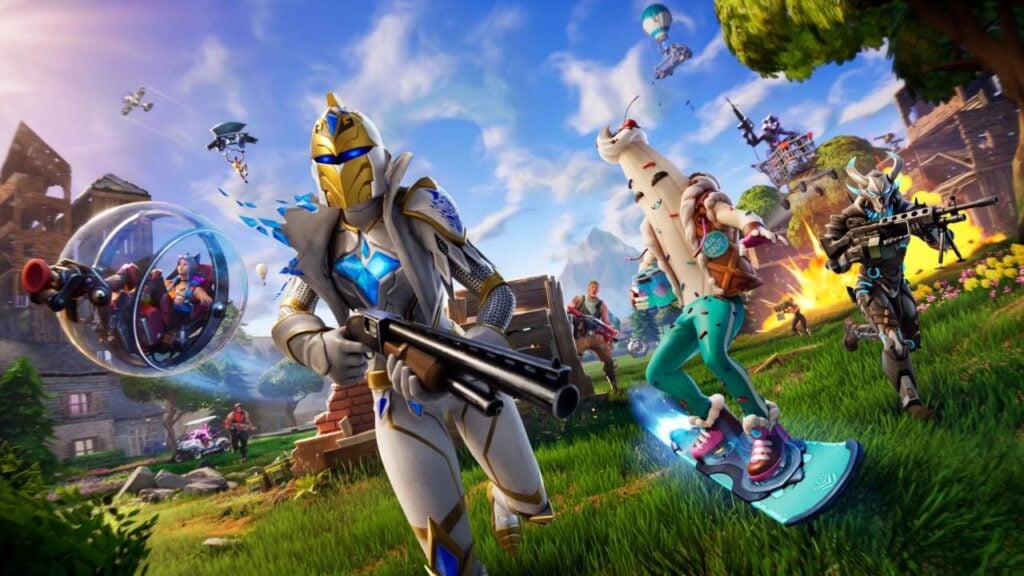
A hundred players parachute onto an island, a storm slowly shrinks the safe zone around them, and only one player or squad walks away with the win. That formula wasn’t new when Fortnite Battle Royale launched in 2017, but Epic Games added one mechanic that changed everything: building. Suddenly winning a fight wasn’t just about aim: it was about who could throw up walls, ramps, and forts faster than the person shooting at them. That single addition turned Fortnite into a completely different game from every other battle royale on the market, and it helped the free-to-play mode explode into one of the most culturally dominant games of its era almost overnight.
On October 13, 2019, at the close of Season X, a rocket collided with a meteor above the island and the entire map collapsed into a black hole, after which the game showed players nothing but a spinning point of light for roughly thirty-six hours while millions watched a live stream of essentially nothing. When it came back, it was Chapter 2, with a new island, swimming, and fishing, and the old map was simply gone. That willingness to delete its own content has defined the game ever since, from Tilted Towers being flattened by a meteor to the Travis Scott concert in April 2020 that drew a reported 12.3 million concurrent players, to a roster of crossover skins that has put John Wick, Master Chief, Darth Vader, and Goku on the same island without anyone treating the arrangement as strange.
Epic Games, founded in 1991 and known across the industry long before this for Unreal Engine, shipped Fortnite in July 2017 as Save the World, a paid cooperative mode in which four players fortify a base against waves of husks. The free battle royale mode followed that September, assembled in a matter of months after PUBG demonstrated how large the audience for the format was, and it eclipsed the original so completely that Save the World was eventually retired from active development. V-Bucks, the in-game currency, buy skins, emotes, and battle passes and nothing that changes the outcome of a fight, a line Epic has held to since the start, and a Victory Royale remains the only thing a match itself awards.
The questions here run across that vocabulary and that history rather than the viral moments surrounding it: the storm and the endgame, the progression and cosmetic systems that fund a game which charges nothing to install, the studio and engine behind the original release, and the named landmarks that came and went between seasons. Anyone who dropped in during Chapter 1 and stopped playing will hit a few unfamiliar entries, since a large share of what defines the game now arrived after the island fell into that black hole and never came back in its original form.
Fortnite rewards a specific kind of memory, the sort that holds patch numbers and season themes rather than highlight clips, and scores here tend to split cleanly between the two kinds of player. Whether the usual drop point was Tilted Towers in 2018 or somewhere on a map replaced twice over since, the results at the end settle which era of the island stuck.
Questions Preview
- Activision
- Epic Games
- Ubisoft
- Valve
- Champion's Circle
- Victory Royale
- Last Stand
- Top Squad
- 50
- 100
- 75
- 120
- Crafting
- Building
- Fortifying
- Base Defense
- Gold Bars
- V-Bucks
- Battle Coins
- Fort Cash
- Battle Pass
- Reward Track
- Season Vault
- Progress Path
- 2015
- 2017
- 2019
- 2013
- The map border
- The storm
- The safe zone timer
- The fog wall
- Unity
- Unreal Engine
- CryEngine
- Source Engine
- Save the World
- Zero Build
- Creative Mode
- Team Rumble
- The Rookie
- The Default
- The Recruit
- The Starter
- Creative Mode
- Sandbox Mode
- Workshop Mode
- Builder Mode
- Ariana Grande
- Travis Scott
- Marshmello
- Drake
- Only sports franchises
- Movies, comics, and other games
- Only anime franchises
- Fortnite does not use crossover skins
- Classic Mode
- Zero Build
- No-Build Royale
- Pure Combat