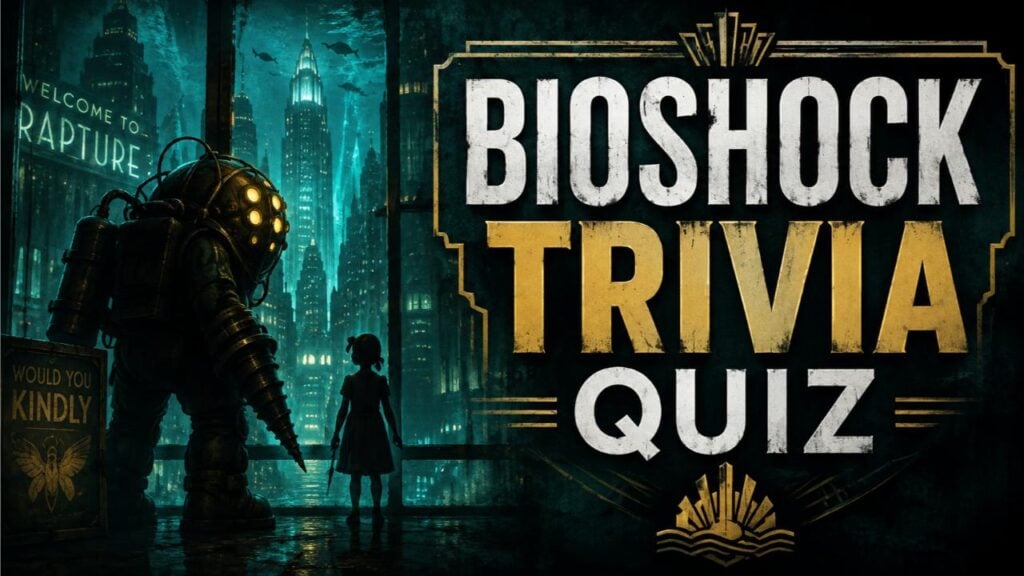
A plane crash strands a survivor in the middle of the ocean, and the only way out turns out to be a lighthouse hiding an elevator down into Rapture, an entire city built on the seafloor by an industrialist who wanted to build a society completely free of government, religion, and any restraint on human ambition whatsoever. By the time the player descends into Rapture, that utopian vision has already collapsed catastrophically, leaving behind flooded art deco hallways, deranged former citizens mutated by unregulated genetic modification, and enough scattered audio recordings to piece together exactly how a philosophy built around unrestrained self-interest tore its own perfect society apart from the inside.
One of the game’s most memorable stretches happens inside Fort Frolic, an entire level built around Sander Cohen, a deranged former artist who traps the player inside his personal gallery and won’t open the parting doors until his final piece is complete. Cohen forces the player to track down and photograph three of his former proteges, each one turned into a posed corpse arranged like a museum exhibit, while his voice narrates over the intercom about beauty and immortality. Splicers frozen mid-pose stand on pedestals around every corner, arranged like gallery pieces rather than attacking on sight the way most of Rapture’s enemies do. The level has almost nothing to do with the city’s founding or its collapse into anarchy, yet it lingers with players longer than several story-critical missions do, mostly because Cohen’s specific brand of theatrical menace stands apart from the desperate, hungry violence found in most of Rapture’s other flooded corridors.
Ken Levine and the team at Irrational Games built Bioshock as a spiritual successor to System Shock 2, carrying over that earlier game’s emphasis on audio logs and environmental storytelling but wrapping it in a new setting and philosophy. Andrew Ryan’s speeches throughout Rapture draw heavily on real objectivist philosophy, close enough to Ayn Rand’s own writing that the parallel became one of the most discussed aspects of the game’s script after release.
The genetic modification system built around plasmids gave players powers like throwing fire or controlling swarms of bees, each one tied back to the same unchecked scientific ambition that doomed the city in the first place. Big Daddies, the lumbering divers welded into pressure suits, follow the Little Sisters through the corridors and have to be put down before one can be reached at all, which is what makes the choice cost something. Choosing whether to harvest or rescue a given Little Sister changes more than a single stat. It shifts which ending the game shows once the story wraps, one of several small decisions that add up across a full playthrough.
The questions ahead ask what phrase triggers the game’s central twist and who founded Rapture in the first place. A couple more get specific about which philosophy shaped the city and what substance powers the plasmid system players rely on throughout. Every answer is laid out just below the final question for whoever wants proof one way or the other.
Questions Preview
- Rapture
- Columbia
- Atlantis
- Eden
- Andrew Ryan
- Frank Fontaine
- Sander Cohen
- Yi Suchong
- Would you kindly
- For the greater good
- As you wish
- By your command
- Big Daddies
- Splicers
- Houdinis
- Rosies
- ADAM
- EVE alone, unrelated to ADAM
- Serum X
- Vita-Chambers
- Plasmids
- Vigors
- Runes
- Sigils
- Frank Fontaine
- Sander Cohen
- Yi Suchong
- Augustus Sinclair
- Splicers
- Big Daddies
- Vita-Chambers
- Rosies
- Harvest or rescue them
- Ignore them entirely
- Recruit them as allies only
- Sell them to Fontaine
- A lighthouse hiding an elevator
- A submarine
- A diving bell only
- A crashed plane wreck itself
- Vita-Chambers
- Healing stations
- Respawn beacons
- Rebirth pods
- Objectivism
- Communism
- Utilitarianism
- Anarchism
- Bioshock Infinite
- Bioshock 2
- Bioshock: Minerva's Den
- Bioshock: Rapture
- 2K Boston/Irrational Games
- Bethesda Game Studios
- Naughty Dog
- Valve
- Art Deco
- Brutalism
- Gothic Revival
- Bauhaus