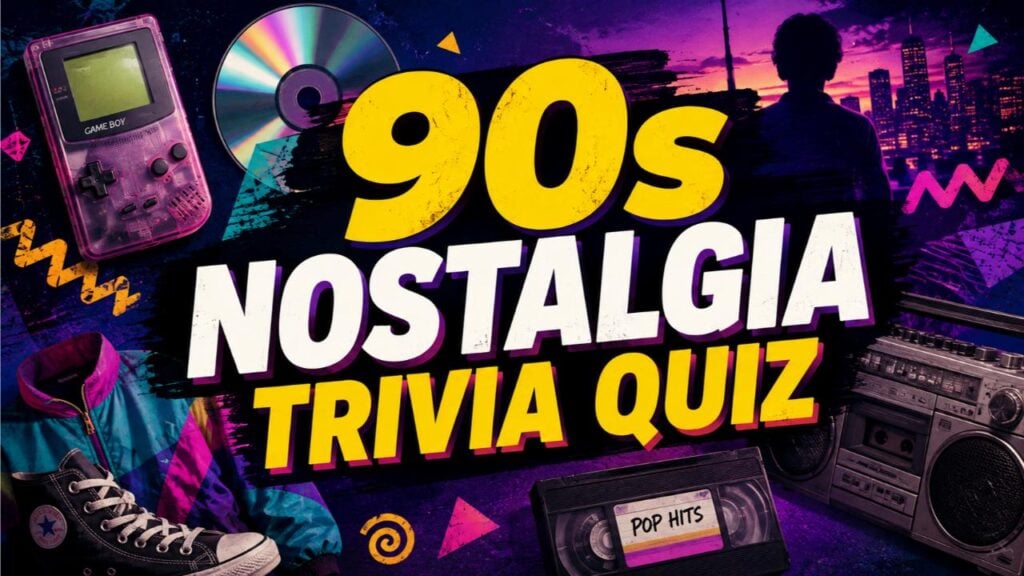
Dial-up internet made a specific screeching noise every time it connected, and an entire generation still knows that sound the second they hear it again. That’s the strange thing about the 90s: so much of what defined the decade wasn’t about big cultural moments, it was about small, physical experiences that don’t exist anymore, rewinding a VHS tape before returning it to the video store, waiting for a Tamagotchi to stop beeping, passing folded paper notes because there was no other way to send a message across a classroom in real time.
Tickle Me Elmo carried a retail price of about thirty dollars when Tyco put it on shelves for Christmas 1996, and within weeks it was changing hands in newspaper classified ads for several hundred, occasionally more, after supply ran out and a store clerk in Canada was trampled by shoppers going for the last cases. Ty Warner ran Beanie Babies on deliberate scarcity, retiring individual designs on a schedule and letting a secondary market decide what a nine-dollar bean-filled bear was worth, which is how the Princess Diana bear released in late 1997 ended up listed for four-figure sums by people convinced they were funding a college education. Bandai’s Tamagotchi arrived from Japan in 1997 and got banned outright in a long list of schools because a plastic egg that died of neglect during third period was more compelling than any lesson competing with it. Furby followed in 1998, sold something like two million units in its first holiday season, and made enough people uneasy about its speech chip that the National Security Agency reportedly barred the toy from its buildings.
Consumer technology sat at an awkward halfway point for most of the decade. Microsoft spent a reported several hundred million dollars launching Windows 95 in August of that year, licensing Start Me Up from the Rolling Stones for the campaign, and people queued outside stores at midnight for an operating system. America Online mailed out free trial discs by the hundreds of millions until the plastic coasters became a running joke. The Nintendo 64 reached North America in September 1996 at just under two hundred dollars, arriving late against Sony’s PlayStation and carrying only a handful of launch titles, one of which rebuilt how three-dimensional games handled a camera and a controller stick.
Music and movies moved on physical media that people had to leave the house to obtain. Nirvana’s Nevermind displaced Michael Jackson’s Dangerous from the top of the Billboard album chart in January 1992, a changeover treated at the time as a formal handover between eras. Blockbuster operated thousands of stores built around new-release walls and late fees, Titanic sat in theaters long enough to pass a billion dollars worldwide after opening in December 1997, and buying a single album often meant buying a compact disc encased in a cardboard longbox designed mainly to deter shoplifting.
Some of these questions land immediately for anyone who grew up in it: what a specific toy was called, what people used before smartphones, how a television episode got saved for later. Others need real precision, like which console won a particular round of the console wars, what year a fad hit its commercial peak, or what a now-obsolete device was officially named rather than what everyone called it. The ones that trip people up are rarely the landmarks, they are the small details, and the full answer key sits directly under the quiz so it is clear which of those details survived the last thirty years intact.
Questions Preview
- A ringing telephone
- A dial-up modem screech
- A camera shutter
- A doorbell chime
- Furby
- Tamagotchi
- Giga Pet Max
- Zhu Zhu Pet
- Vinyl records
- 8-track tapes
- CDs
- MP3 players
- DVD
- VHS tape
- Laserdisc
- Betamax tape
- Nintendo 64
- Sony PlayStation
- Atari Jaguar
- 3DO
- Disco
- Grunge
- New Wave
- Synth-pop
- On-demand apps
- Wait for a rerun
- Download it online
- Ask a friend to record it live
- Beanie Babies
- Pogs
- Silly Bandz
- Skip-It
- A folded paper note
- A pager message
- A voicemail
- Cabbage Patch Kids
- Beanie Babies
- Care Bears
- My Little Pony
- A record store
- A video rental store
- A bookstore
- An arcade
- Seinfeld
- Friends
- Cheers
- Frasier
- A pager
- A Walkman
- A Discman
- A PDA stylus
- A smartphone
- A Walkman
- Wireless earbuds
- A streaming app
- Extremely thin and small
- Large and brick-like
- Foldable and flexible
- Wrist-mounted