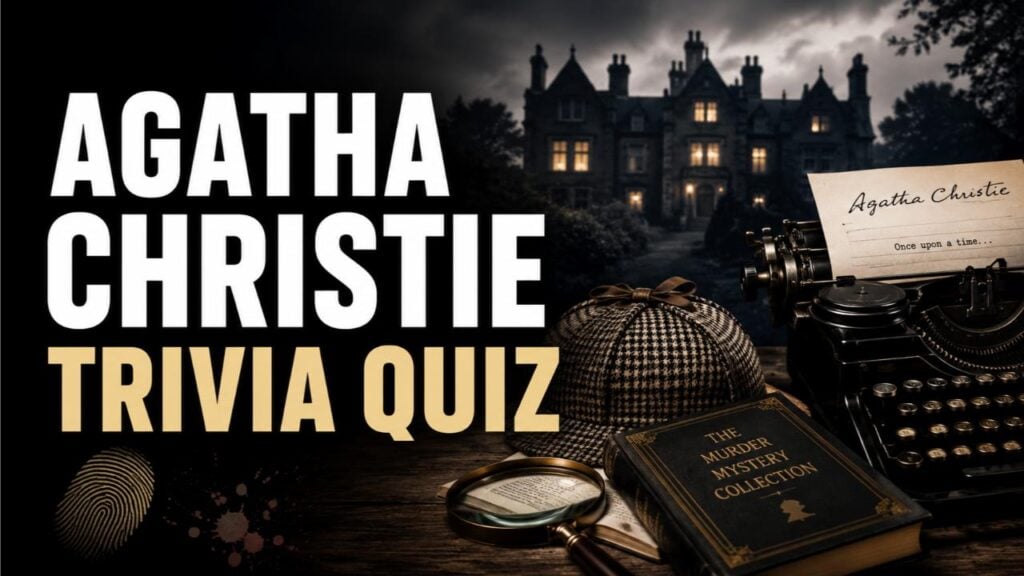
Agatha Christie vanished for eleven days in 1926, and to this day nobody has ever fully settled why. Her car was found abandoned, a national search effort followed, and she eventually turned up registered under a different name at a hotel. It’s a strange, unresolved footnote in the life of a woman who spent her career writing some of the most carefully engineered, tightly resolved mystery plots ever published, someone who, according to Guinness World Records, remains the best-selling novelist of all time regardless of genre.
The Murder of Roger Ackroyd, published that same year, caused an argument in the crime-writing world that took a decade to settle, because its solution depends on a piece of misdirection several critics insisted amounted to cheating the reader outright. The dispute helped push the Detection Club toward codifying rules of fair play at the end of the 1920s, a set of commandments written partly to prevent exactly the trick she had just pulled off, and in 2013 the Crime Writers’ Association voted the same novel the finest crime story ever written.
Her handling of poison came from paid work rather than research. Christie spent the First World War in a hospital dispensary in Torquay, qualified to handle and compound drugs, and the knowledge runs through the novels with a precision most authors never attempt, starting with The Mysterious Affair at Styles in 1920, in which a strychnine death is worked out on chemical grounds. The best-documented consequence came decades later, when a nurse in London recognized the symptoms of thallium poisoning in a patient after reading The Pale Horse, published in 1961.
The two detectives who carry most of the work were built to be opposites. Hercule Poirot, the fastidious Belgian refugee with the moustache and the little grey cells, was retired in Curtain, a novel she wrote during the Second World War and locked away for thirty years, and when it finally appeared in 1975 The New York Times ran a front-page obituary for a fictional man. Jane Marple, introduced in short stories in the late 1920s and given a novel of her own in The Murder at the Vicarage in 1930, works instead by analogy, matching a murder in a foreign capital to something a neighbour once did in St Mary Mead, and is consistently underestimated by everyone in the room until the final chapter.
The volume behind the reputation is the part that tends to surprise people. Roughly sixty-six detective novels, over a hundred short stories, six romances published under the name Mary Westmacott, and The Mousetrap, which opened in the West End in 1952 and has run more or less continuously since, having begun life as a short radio play written at the request of the Queen. And Then There Were None alone has sold somewhere above a hundred million copies. Her second marriage, to the archaeologist Max Mallowan in 1930, put her on excavation sites in Iraq and Syria for years and supplied the settings for several of the novels people remember most vividly.
Some of this is common knowledge to anyone who has read one book: the famous detective’s name, the general shape of a country-house solution. The rest calls for real recall, like which novel carries the twist that started the argument, what year a particular title first appeared, or which real crime fed a plot. A mystery solved on sight and one that still works exactly as it did on readers a century ago look identical right up until the printed answers sort the two apart.
Questions Preview
- Sherlock Holmes
- Hercule Poirot
- Father Brown
- Lord Peter Wimsey
- Miss Marple
- Miss Havisham
- Tuppence Beresford
- Ariadne Oliver
- 'The facts don't lie'
- 'The little grey cells'
- 'Elementary reasoning'
- 'Careful observation'
- Witness for the Prosecution
- The Mousetrap
- Black Coffee
- Spider's Web
- 1920
- 1926
- 1933
- 1940
- American
- British
- French
- Irish
- A steamship
- A train
- An airplane
- A carriage
- Death on the Nile
- And Then There Were None
- The ABC Murders
- Evil Under the Sun
- The Thames
- The Nile
- The Seine
- The Danube
- Best-selling mystery author only
- Best-selling novelist of all time
- Best-selling British author only
- Best-selling 20th century author only
- Tommy and Tuppence
- Jack and Jill
- Harry and Sally
- Tom and Amy
- A nurse
- A pharmacy dispenser
- A military doctor
- A chemist's assistant only
- Ariadne Oliver
- Miss Marple
- Tuppence Beresford
- Lucy Eyelesbarrow
- Murder on the Orient Express
- The Mysterious Affair at Styles
- The Murder of Roger Ackroyd
- Death on the Nile
- Belgian
- Swiss
- Dutch
- Luxembourgish