On the morning of 12 April 1961 a Soviet air force pilot named Yuri Gagarin lay strapped into a capsule called Vostok 1 at the Baikonur launch site and, as the rocket lifted off, called out Poyekhali, which translates roughly as let's go. He circled the Earth once and came down by parachute after ejecting from the capsule, a detail Soviet officials kept quiet for years because the rules for aviation records expected a pilot to land with his craft. The flight lasted about an hour and three quarters, and it made him the most famous man alive.
The Soviet Union had opened the contest three and a half years earlier. Sputnik 1, launched on 4 October 1957, was a polished metal sphere a little under 60 centimetres across with four long antennas trailing behind it, and it did nothing more than broadcast a steady radio beep that amateur operators around the world could pick up. The political effect was enormous. The United States created NASA the following year and poured money into science education, and within weeks of Gagarin's flight President Kennedy had committed the country to landing a man on the Moon before the decade was out.
Apollo 11 met that deadline on 20 July 1969, when Neil Armstrong and Buzz Aldrin set the lunar module Eagle down on the Sea of Tranquility while Michael Collins waited in orbit aboard Columbia. Ten more men walked on the Moon over the next three and a half years, the last of them on Apollo 17 in December 1972. The mission people remember almost as well never landed at all. Apollo 13 was on its way out in April 1970 when an oxygen tank exploded in the service module, and Jim Lovell, Jack Swigert and Fred Haise used the lunar module as a lifeboat to swing around the Moon and return safely. Spaceflight also had its losses. The shuttle Challenger broke apart 73 seconds after launch on 28 January 1986, killing all seven crew, among them the schoolteacher Christa McAuliffe.
Living in orbit became the long project after the Moon. The Soviet station Mir was assembled from 1986 and hosted crews for most of the next fifteen years before it was brought down into the Pacific in 2001. The International Space Station, built by the United States, Russia, Europe, Japan and Canada, has had people aboard without a break since November 2000. Telescopes went up as well. Hubble reached orbit in 1990 with a flawed mirror that blurred its first images, and astronauts fitted corrective optics during a servicing mission in 1993. The James Webb Space Telescope followed on Christmas Day 2021, launched on an Ariane 5 rocket from French Guiana, and now observes in infrared from a point about 1.5 million kilometres beyond Earth. Further out still, Voyager 1, launched in 1977, crossed into interstellar space in 2012 and remains the most distant object people have ever built.
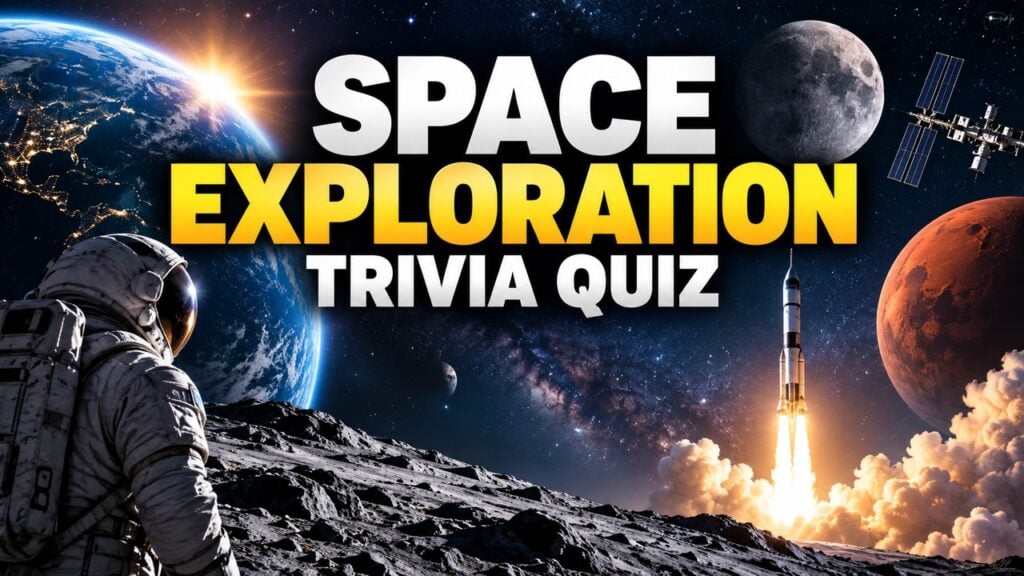
Mars has been visited by a series of NASA rovers, including Curiosity, which landed in Gale Crater in 2012, and Perseverance, which reached Jezero Crater in 2021 to look for signs of ancient microbial life and to collect and seal rock samples meant for possible return to Earth. The newest chapter is commercial. SpaceX, founded by Elon Musk in 2002, landed the first stage of an orbital rocket upright in 2015 and began flying NASA astronauts to the station in 2020. The questions cover that whole span, from the first beep in orbit to the telescopes working today, and each answer appears below the quiz.
Questions Preview
- Telstar 1
- Sputnik 1
- Vostok 1
- Voyager 1
- Valentina Tereshkova
- Sally Ride
- Svetlana Savitskaya
- Eileen Collins
- Neil Armstrong
- Buzz Aldrin
- Yuri Gagarin
- John Glenn
- Apollo 8
- Apollo 13
- Apollo 11
- Gemini 8
- Neil Armstrong
- Yuri Gagarin
- John Glenn
- Alan Shepard
- Vanguard 1
- Telstar 1
- Sputnik 2
- Explorer 1
- Skylab
- The International Space Station
- Mir
- Tiangong
- Blue Origin
- Virgin Galactic
- SpaceX
- Boeing
- New Horizons
- Pioneer 10
- Cassini
- Voyager 1
- The Hubble Space Telescope
- The James Webb Space Telescope
- The Kepler Space Telescope
- The Spitzer Space Telescope
- Apollo 1
- Gemini 8
- Apollo 11
- Apollo 13
- Skylab
- Tiangong
- Mir
- Salyut 1
- The Kepler Space Telescope
- The James Webb Space Telescope
- The Chandra X-ray Observatory
- The Spitzer Space Telescope
- The Columbia disaster
- The Apollo 1 fire
- The Challenger disaster
- The Soyuz 11 disaster
- Perseverance
- Curiosity
- Opportunity
- Sojourner