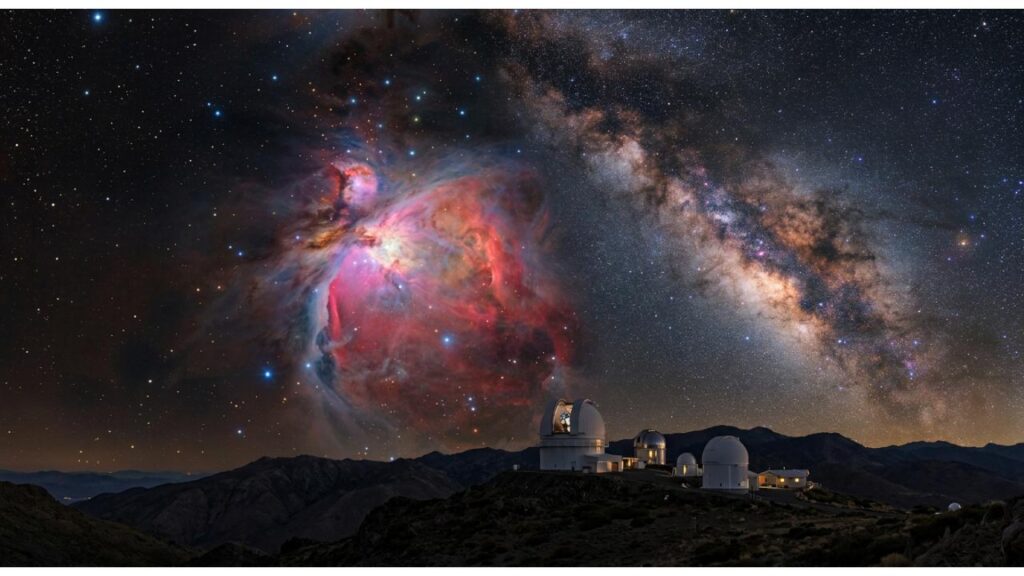
Look up on a clear night and you’re seeing light that, in some cases, left its source before human civilization existed. That’s the strange thing about astronomy: it’s the one science where you’re never looking at the present. You’re looking at the past, sometimes by minutes, sometimes by millions of years, depending on how far away the light you’re seeing traveled from. Space has fascinated humanity for as long as people have looked up, but it wasn’t until the last century that we left the planet, sent probes past the edges of the solar system, and started to understand what’s out there instead of just theorizing about it.
Venus orbits farther from the sun than Mercury does and is still the hottest planet in the solar system, its surface holding near 465 degrees Celsius beneath a carbon dioxide atmosphere so heavy that the Soviet Venera landers of the 1970s transmitted for barely an hour before the pressure finished them off. Astronomy is full of results like that, where the intuitive answer and the correct one part company, and where the accepted picture keeps shifting under people who thought it was settled. Pluto held its position as the ninth planet until the International Astronomical Union voted in Prague in August 2006 to reclassify it as a dwarf planet, a decision still resented by anyone who memorized the old order in a classroom. Black holes moved from mathematics to photography in April 2019, when the Event Horizon Telescope released an image of the shadow at the center of M87, assembled from radio dishes spread across four continents and synchronized by atomic clocks.
The record of leaving the planet is similarly specific. Sputnik 1 went up on October 4, 1957 and did little beyond emitting a radio beep, which was enough to start a competition that ran hard for the next twelve years. Yuri Gagarin completed a single orbit in April 1961, Neil Armstrong and Buzz Aldrin landed at the Sea of Tranquility on July 20, 1969 while Michael Collins circled overhead alone in the command module, and Voyager 1, launched in 1977 for a tour of the outer planets, crossed the heliopause in 2012 and continues sending back readings from beyond the sun’s influence.
The questions here draw across that whole range: the planets and the features that identify them, from the iron oxide dust that gives Mars its color to the storm that has been turning in Jupiter’s atmosphere since observers first sketched it in the seventeenth century, the missions and the names attached to them, the Milky Way and its rough span of 100,000 light years, and the extreme objects and measurements at the far end, including the units astronomers reach for once kilometers stop being useful.
Some of it rests on knowledge most people retain without effort, such as which planet sits nearest the sun or who stepped onto the lunar surface first. Other questions ask for sharper recall: which planet runs hottest despite its position in the order, which one carries the most prominent ring system, what a light year measures and what it does not, and the exact status Pluto holds today. Anyone who clears all of that has more than a passing interest in the subject, and the full set of questions with their correct answers sits below the quiz for checking where the gaps turned up.
Questions Preview
- Venus
- Mercury
- Earth
- Mars
- Saturn
- Jupiter
- Neptune
- Uranus
- Venus
- Mars
- Mercury
- Jupiter
- Buzz Aldrin
- Neil Armstrong
- Yuri Gagarin
- John Glenn
- Andromeda
- The Milky Way
- The Triangulum Galaxy
- The Sombrero Galaxy
- A kilometer
- A light-year
- A parsec only
- An astronomical mile
- Jupiter
- Saturn
- Uranus
- Neptune
- 1998
- 2006
- 2012
- 1990
- Mercury
- Venus
- Mars
- Jupiter
- Apollo 8
- Apollo 11
- Gemini 4
- Apollo 13
- Polaris
- The Sun
- Sirius
- Proxima Centauri
- An empty region of space with nothing in it
- A region where gravity is so strong nothing can escape it
- A collapsed star that emits light
- A type of comet
- The James Webb Telescope
- The Hubble Space Telescope
- The Kepler Telescope
- The Spitzer Telescope
- The United States
- The Soviet Union
- China
- Germany
- Seven
- Eight
- Nine
- Ten