A ten-year-old kid leaves home with a starter creature and a handful of empty capsules, and nearly three decades later that same basic premise has become one of the highest-grossing media franchises ever created. Pokemon launched in 1996 as a pair of Game Boy titles and quietly turned into games, a trading card empire, an anime that’s been running continuously since 1997, and a cultural fixture that’s introduced literal generations of kids to the same starting choice: fire, water, or grass. Few franchises have stayed this consistently relevant across this many decades without ever really rebooting their core idea.
Water beats Fire, Fire beats Grass, Grass beats Water, and that closed triangle is the first thing any player learns and the last thing the series ever changes. Everything around it has moved. The original games shipped with fifteen types; Dark and Steel arrived in 1999 with Gold and Silver to rein in Psychic, which had been close to unbeatable, and Fairy arrived in 2013 with X and Y to do the same to Dragon, which until then could only be answered by Ice or by another Dragon, leaving the chart at eighteen types and several hundred possible matchups. A hit lands for double damage, half damage, or none at all, which is why a Normal-type attack passes straight through a Ghost, and why type coverage rather than raw stats decides most serious battles.
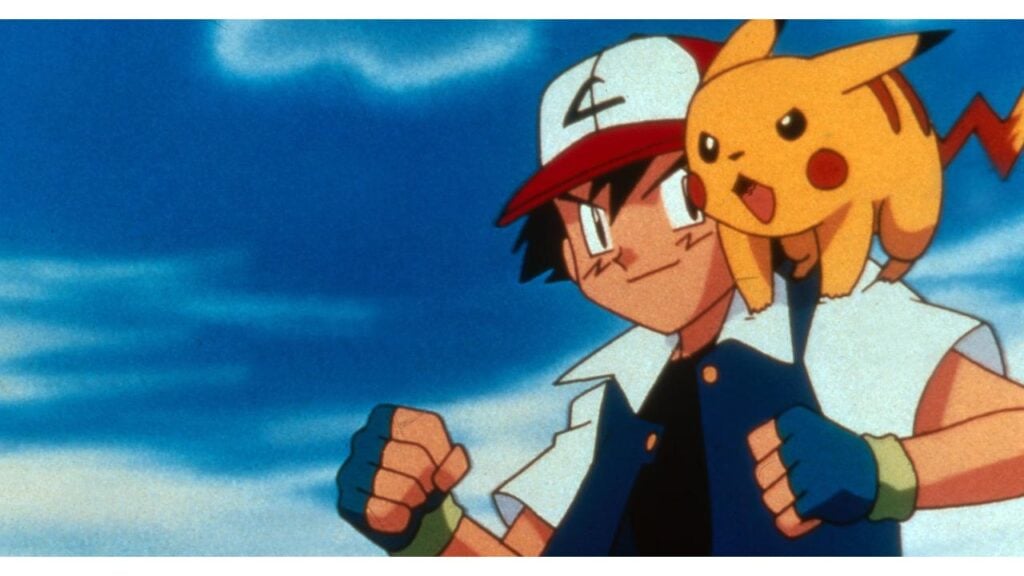
Behind that sits a franchise built by Game Freak under Satoshi Tajiri, who spent six years developing the first games out of a childhood spent collecting insects outside Machida, with Ken Sugimori designing the original 151 creatures and Nintendo publishing the result in February 1996. The species count has since passed a thousand across nine generations, each of which introduced a new region, a new professor handing out a starter and a Pokedex, a new legendary tied to that region’s creation myth, and a new rival. Ash Ketchum carried the anime through most of that, losing league finals for two decades before winning the Alola league and then the World Coronation Series, at which point the series retired him and started over with two new leads in 2023.
Questions run from the parts everyone absorbed by osmosis to the parts that require having played. The starter trio of Bulbasaur, Charmander and Squirtle, the mascot, and the name of the anime’s protagonist sit at the easy end. Further in are the type that answers a Water-type sweep, the final form Charmander reaches after two evolutions, the identity of Professor Oak’s grandson who turns up at every gym to gloat, and which company developed the original games while Nintendo published them, a distinction plenty of lifelong fans get backwards.
Anyone whose knowledge stopped at the first 151 will find the middle generations rough going, since the questions reach past Kanto into the legendaries, mechanics and regional structures added later. The complete list of questions with their correct answers sits below the quiz, which is the fastest way to work out whether the weak spot is a whole generation or just the type chart.
Questions Preview
- Charizard
- Pikachu
- Eevee
- Mewtwo
- Fire, Water, Grass
- Fire, Ice, Rock
- Water, Electric, Grass
- Grass, Ground, Fire
- Gary Oak
- Ash Ketchum
- Brock
- Misty
- Fire
- Electric
- Ground
- Rock
- Charmeleon
- Charizard
- Blastoise
- Arcanine
- Paul
- Gary Oak
- Trip
- Blue
- Square Enix
- Game Freak
- Capcom
- Sega
- Professor Birch
- Professor Oak
- Professor Elm
- Professor Willow
- Pokedex
- Poke Ball
- Capture Disk
- Battle Sphere
- 100
- 151
- 200
- 120
- Poke Ball
- Pokedex
- Trainer Card
- Battle Scanner
- Fairy
- Ghost
- Dark
- Steel
- Mega Evolution
- Evolution
- Ascension
- Transformation
- Misty
- May
- Dawn
- Serena
- Mewtwo
- Charizard
- Articuno
- Zapdos