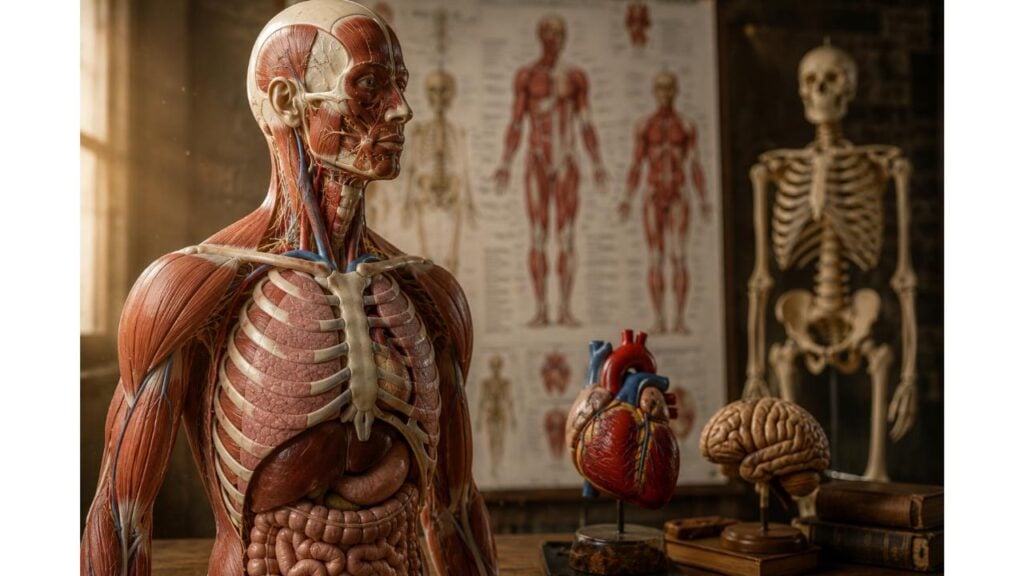
Most people spend a lifetime inside a body they could not describe under mild questioning: how many bones it contains, which organ is the largest, what the two halves of a single heartbeat are doing. That is not surprising. Biology class covers an enormous quantity of material in a short stretch of time, and almost none of it survives unless someone works in medicine or keeps reading about it afterward. The human body is the most complex system most people will ever interact with daily, and the working understanding most of us carry around is thinner than the subject deserves.
An adult skeleton contains 206 bones. A newborn starts with somewhere around 270, and the extras fuse over childhood, which is why an infant skull has soft gaps and an adult skull does not. The smallest of the 206 is the stapes, in the middle ear, roughly three millimetres long and lighter than a grain of rice, and the largest is the femur, which accounts for close to a quarter of a person’s height. Figures like these tend to be half remembered and confidently misstated, and the pattern repeats across the body: 46 chromosomes arranged in 23 pairs, four chambers in the heart, an estimated 60,000 miles of blood vessels, and roughly 60 percent of an adult’s mass in water.
Organs invite the same corrections. The skin is the body’s largest organ by both surface area and weight, at something near 16 percent of total body mass, which displaces the answer most people reach for first. The liver is the largest internal organ and the only one that regenerates lost tissue in any meaningful quantity, while the lungs are asymmetrical, the left carrying two lobes rather than three to leave room for the heart, which sits nearer the center of the chest than the left-side diagram in most people’s heads suggests. Stomach acid runs near pH 1.5, corrosive enough that the lining holding it replaces itself every few days. Red blood cells carry oxygen on hemoglobin, an iron-bearing protein that gives blood its colour and is replaced at a rate of roughly two million cells a second, and a full adult set of teeth runs to 32 once the four wisdom teeth arrive, a number that shrinks again for the many people who have them removed.
The quiz stays within standard secondary-school anatomy and physiology rather than clinical detail: the skeletal and circulatory systems, the organs and what each one does, the counts and measurements that appear in every textbook, and a handful of facts about cells and the senses. Nothing here requires a medical background, though several questions reward anyone who held onto a biology textbook after the exam, or who has since read enough to know that the commonly taught count of the senses is a simplification of a much longer list.
Anatomy trivia carries a particular sting, since every answer describes something the person answering is carrying around while they answer it. Whether that 206 figure was genuinely remembered or quietly reconstructed in the moment becomes obvious as soon as the results print.
Questions Preview
- The liver
- The skin
- The brain
- The lungs
- 186
- 206
- 226
- 196
- The lungs
- The heart
- The liver
- The kidneys
- The heart
- The liver
- The stomach
- The kidneys
- The hand
- The ear
- The foot
- The skull
- Two
- Four
- Three
- Six
- The tibia
- The femur
- The humerus
- The spine
- Collagen
- Hemoglobin
- Keratin
- Insulin
- 28
- 32
- 30
- 36
- 21
- 23
- 25
- 20
- The digestive system
- The immune system
- The nervous system
- The respiratory system
- The liver
- The kidneys
- The bladder
- The pancreas
- Around 30 percent
- Around 60 percent
- Around 90 percent
- Around 15 percent
- The spinal cord
- The brain
- The heart
- The pituitary gland
- Physiology
- Anatomy
- Pathology
- Genetics