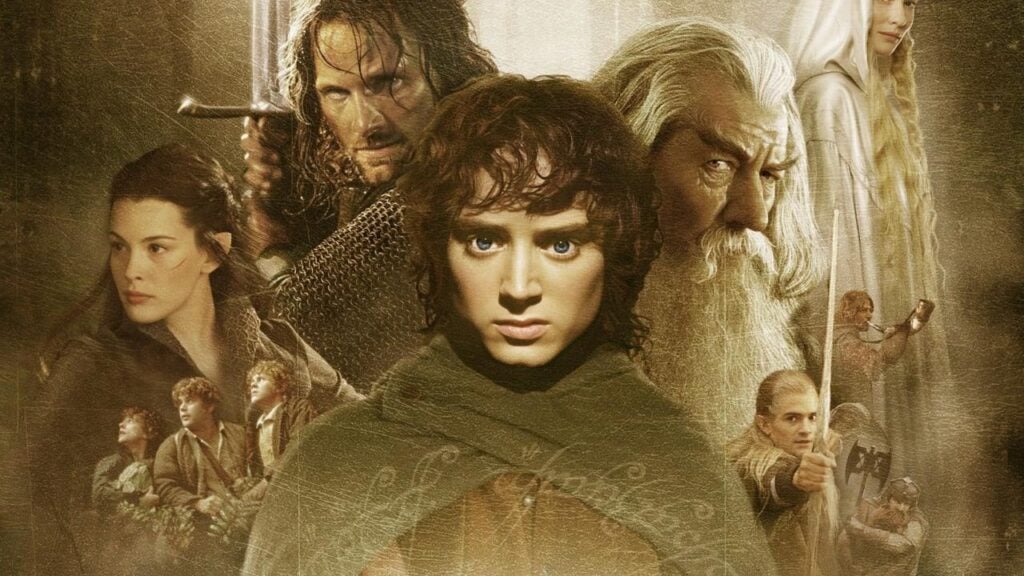
A small hobbit from a quiet corner of the Shire inherits a plain gold ring from his uncle, and by the time anyone realizes what that ring is, half of Middle-earth is already at war over it. J.R.R. Tolkien’s The Lord of the Rings didn’t just define modern fantasy: it created the template almost every fantasy story since has borrowed from in some form, from the found-family fellowship structure to the reluctant hero who never wanted the burden he’s been handed. Peter Jackson’s film trilogy brought that story to an entirely new generation in the early 2000s, and more than twenty years later it’s still regarded as one of the most faithful, ambitious adaptations ever attempted.
Sixty years pass between Bilbo picking the Ring off the floor of a cave under the Misty Mountains and Gandalf holding it over a fire in Bag End to read the inscription that confirms what it is. Before that it spent close to five centuries with Gollum, and before that roughly two and a half thousand years in the riverbed of the Anduin, having slipped off Isildur’s finger while he was being shot at by orcs. Tolkien wrote the story on that timescale deliberately, which is why the wars of the Third Age read as the last stage of an argument begun in the Second, and why Elrond can speak about the moment Isildur refused to destroy the Ring as something he personally witnessed.
Numbers in the story tend to be answers to other numbers. The Fellowship is set at nine walkers to stand against nine riders, and it holds for exactly as long as it takes Boromir to break at Amon Hen. Gandalf goes down with the Balrog at Khazad-dûm and returns as the White, which is less a promotion than a replacement, since Saruman has by then vacated the position. Aragorn spends three volumes avoiding a throne he has an unbroken claim to through Isildur, and the prophecy that no man could kill the Witch-king of Angmar is answered by a woman of Rohan and a hobbit with a Barrow-blade, working together and neither of them qualifying.
The questions cover the whole route from Bag End to Mount Doom. Straightforward ones ask who carries the Ring for most of the journey, who held it before Bilbo, and where it has to be unmade. Less straightforward ones ask how many members the Fellowship starts with, which ancestor gives Aragorn his claim to Gondor, which two characters together bring down the Witch-king on the Pelennor Fields, and the exact circumstances under which the Ring finally goes into the fire, which is not a heroic act by anyone involved.
Readers of the books and viewers of the films both have footing here, though the geography and the lines of succession trip up more people than the battles do. All the questions and their correct answers are listed below the quiz, which is the quickest way to find out which kingdom or which sword got attributed to the wrong owner.
Questions Preview
- Bilbo Baggins
- Frodo Baggins
- Samwise Gamgee
- Aragorn
- Sauron
- Gollum
- Saruman
- Shelob
- Mount Doom
- The Misty Mountains
- Erebor
- Weathertop
- Seven
- Nine
- Eleven
- Eight
- Legolas
- Boromir
- Gimli
- Aragorn
- Gandalf the Wise
- Gandalf the White
- Gandalf the Bright
- Gandalf the Grand
- He is the heir of Isildur and rightful King of Gondor
- He is the last dwarf king
- He is Sauron's brother
- He is the Elven king of Mirkwood
- Dwarf
- Elf
- Hobbit
- Man
- Gloin
- Balin
- Thorin
- Dain
- Radagast
- Saruman
- Gandalf
- Alatar
- Gondor
- Rohan
- Mirkwood
- Moria
- Aragorn
- Eowyn
- Gandalf
- Frodo
- Frodo throws it into Mount Doom willingly
- Gollum falls into Mount Doom while holding it
- Sauron destroys it himself
- Sam melts it down separately
- C.S. Lewis
- J.R.R. Tolkien
- George R.R. Martin
- Terry Pratchett
- Rivendell
- The Shire
- Gondor
- Bree