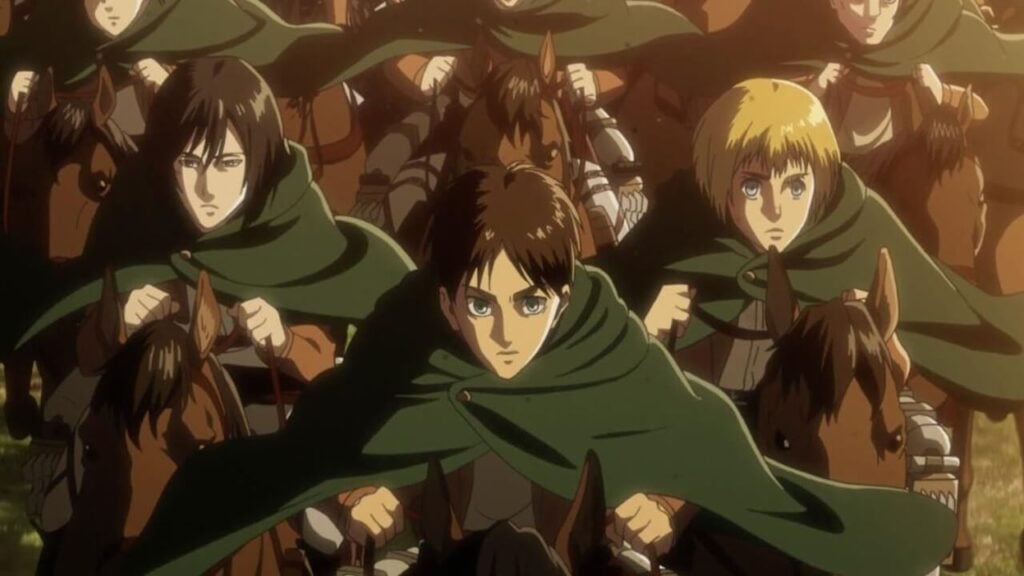
Hajime Isayama serialized Attack on Titan in Bessatsu Shonen Magazine from September 2009 to April 2021, finishing at thirty-four volumes, and the story he ended with is not the story most readers thought they had started. The first chapters look like a survival premise: three concentric walls, a population that has never seen the outside, and giant humanoid creatures that eat people for no discernible reason. By the end, the walls, the monsters and the enemy have all been redefined at least twice, and the question has shifted from how humanity survives to whether it deserves to.
That reversal is why the cast makes such unusually sharp personality material. Almost every character is defined by a choice made under conditions where every available option is wrong, and the series keeps asking whether the person was right rather than whether they were brave. Erwin Smith sends his soldiers to die knowing he is doing it partly to satisfy his own curiosity, and says so out loud. Reiner Braun holds two incompatible identities in one head until it breaks him. Armin Arlert survives because someone decided his intelligence was worth more than another man’s life, and he has to live inside that decision.
The results cover a genuinely wide spread. Eren Yeager begins as pure rage pointed at a target and ends as something far colder, having decided that freedom justifies almost anything. Mikasa Ackerman is loyalty concentrated into one person, terrifyingly capable and largely uninterested in causes. Levi Ackerman is the most skilled soldier alive, blunt, obsessive about cleanliness, and quietly carrying every death he failed to prevent. Hange Zoe studies the creatures that killed her friends with delighted scientific curiosity and treats that as a form of resistance. Historia Reiss spends most of the story making herself small and agreeable before finding out she is the legitimate heir and deciding what to do with it.
Further along, Annie Leonhart is efficiency without illusions, Ymir is sardonic self-interest bent by one attachment she cannot argue herself out of, and Zeke Jaeger is an ideologue who believes ending something gently is a kindness. Jean Kirschtein joined for the safe posting in the interior and becomes the closest thing the group has to a functioning leader. Conny Springer covers fear with jokes. Sasha Braus is a hunter from a mountain village who is funnier than her circumstances allow her to be. Marco Bodt dies early and shapes Jean permanently. Miche Zacharius, the second strongest soldier in the Survey Corps, identifies threats by smell. Floch Forster is the ordinary survivor who turns his survival into a movement.
The questions ask what you do when orders are wrong, whether you protect a person or a principle, and how much you are willing to lose. Answer plainly. This is a story with very few clean results, and the accurate one may not be the one you were hoping for.
Possible results:
- Eren Yeager
- Historia Reiss
- Ymir
- Mikasa Ackerman
- Levi Ackerman
- Armin Arlert
- Annie Leonhart
- Hange Zoë
- Erwin Smith
- Reiner Braun
- Zeke Jaeger
- Jean Kirschtein
- Conny Springer
- Sasha Braus
- Marco Bodt
- Miche Zacharius
- Floch Forster