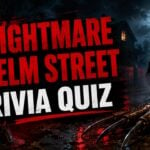
Teenagers on the same quiet street start having the exact same nightmare about a burned man in a striped sweater with knives for fingers, and the horror of A Nightmare on Elm Street comes from the simple, terrifying rule Wes Craven built the film around: whatever happens to you in that dream happens to your actual body too, which means falling asleep stops being a refuge and starts being the single most dangerous thing any of these kids can do. Freddy Krueger wasn’t just another masked slasher wandering around a fixed location either; by putting him inside his victims’ dreams, Craven found a way to make the villain inescapable.
Craven spent roughly three years carrying the script around Hollywood before anyone would fund it, and the company that finally did, New Line Cinema, was at the time a distributor with almost no production history and not enough money to cover the shoot comfortably. The film was made for something close to 1.8 million dollars, opened on November 9, 1984, and took in more than twenty-five million in the United States, which rescued a struggling company so completely that New Line spent the next two decades being called the house that Freddy built. One of the teenagers swallowed by the bed in the middle of it was Johnny Depp, then a twenty-one-year-old musician with no acting credits who had come along to keep a friend company at the audition and left with his first film role.
Craven picked red and green for the sweater after reading that the two colors sit at an especially uncomfortable distance for the human eye, and the glove was built as a welded gardening-tool hybrid rather than a manufactured prop, on the reasoning that an improvised weapon reads as more disturbing. Robert Englund sat through hours of prosthetic application for a character kept in shadow and half-frame for most of the running time. The scene in which a bed erupts vertically was shot in a rotating set with a camera bolted to the floor, using stage blood measured in the hundreds of gallons.
Underneath the mechanics sits a fairly bleak moral premise. Freddy escaped prosecution on a procedural technicality and was then burned alive by a group of parents from the neighborhood, which means the thing killing these teenagers is the direct consequence of what the previous generation did and never mentioned again. Nancy Thompson responds by treating him as an engineering problem, rigging trip-wires and mallets and keeping herself awake on coffee and willpower. Craven and producer Robert Shaye argued over the ending, Craven wanting a resolution and Shaye wanting the door left open, and the compromise on screen is why eight further films exist.
The premise came from newspaper reporting rather than invention. Craven read a series of Los Angeles Times pieces about young Southeast Asian refugees who had died in their sleep shortly after describing recurring nightmares so severe they were trying not to sleep at all, a phenomenon doctors still classify without fully explaining. That grounding is part of why the film was selected for the National Film Registry in 2021.
The easy questions cover the obvious ground: the glove, the sweater, the rule about sleep, Nancy as the survivor. The harder ones want the specifics, like the children’s rhyme that follows Freddy through the series, which future star made his debut here, and what Freddy did for work before the parents caught up with him. Every question reappears with its correct answer under the quiz, so the gaps are easy to spot before the next rewatch.
Questions Preview
- John Carpenter
- Wes Craven
- Sean Cunningham
- Tobe Hooper
- Freddy Krueger
- Jason Voorhees
- Michael Myers
- Leatherface
- He can only attack during a full moon
- What happens to you in the dream happens to your real body
- He can only be seen by one victim at a time
- He must be invited into a home
- Nancy Thompson
- Tina Gray
- Laurie Strode
- Marge Thompson
- A chainsaw
- A bladed glove
- A machete
- A hockey mask and knife
- He was executed by the state
- He was killed by a group of vigilante parents
- He died in a house fire accidentally
- He was never actually human
- Arson
- Child murder
- Robbery
- Kidnapping for ransom
- Johnny Depp
- Brad Pitt
- Tom Cruise
- Keanu Reeves
- Leave town entirely
- Stay awake and avoid falling asleep
- Confront Freddy's remaining family
- Find a hidden weapon
- Maple Street
- Elm Street
- Oak Street
- Birch Street
- Trap and defeat him using engineered traps
- Simply run away permanently
- Negotiate with him
- Call the police for help
- A teacher
- A groundskeeper at the local school
- A police officer
- A factory worker
- Robert Englund
- Jackie Earle Haley
- Ted Levine
- Doug Bradley
- She reveals she was part of the group that killed Freddy
- She denies Freddy ever existed
- She turns out to be working with Freddy
- She leaves town before the climax
- One, two, Freddy's coming for you
- Freddy Freddy, burning bright
- Elm Street's calling, don't you fight
- Sleep tight, don't let Freddy bite